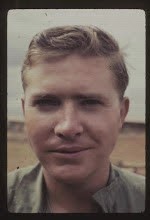
September 1968: We had spent a restless night at the "Oasis", a brigade headquarters of the 4th Infantry Division, southwest of Pleiku, in the Central Highlands of Vietnam. There was a relatively small "sapper" attack, consisting of a few enemy soldiers who were able to crawl through our multi-layered barbed wire, to throw satchel charges at our tanks and personnel carriers. There were perhaps a dozen to twenty casualties among us that day, and one of our guys had lost an arm during the enemy mortar fire which prepared the diversion for the sappers.
Since I was a visitor and had no assigned duties on that base, I volunteered to provide security for the stretcher bearers while they took him to the helicopter pad. One of the positive experiences during combat is the feeling of cameradery, and most of those who share a high risk event seem to feel compelled to do their part, in order to help their comrades to survive. People who have never met, and may never meet each other again, suddenly become part of an intimate family, and they do what they can for each other. Then there is the dark side of that experience:
On the following morning, I was finally able to go on the mission, which was the purpose of my visit to that barren "oasis". With three armored personell carriers, we were to find a Montagnard village twenty miles to the west of our base, where there had been some enemy action a few days earlier, have our medic push a few pills, and find out what we could about the enemy situation in the area.
Halfway there, a young Vietnamese girl, perhaps ten to twelve years old, appeared about two hundred meters on our right flank, her right hand holding a curved one or two foot knife, which was commonly used for harvesting rice. I suspected that she or her family was hungry, and she had been sent to another family's field to steal a little rice. When our APC's approached, she had jumped up suddenly from the concealment of the ricefield, and bounded like a frightened deer toward the protection of a row of trees only thirty feet to her front. Instinctively, one of the M-60 gunners on our vehicle opened up toward her.
Amid the roar of the engine and the chatter of the gun, voice communication seemed impossible, so I tapped on his helmet, and shook my head. He glanced at the captain bars on my helmet and nodded, while the girl safely reached the the treeline and disappeared. Fortunately, perhaps because our APC was bouncing over some potholes, he had not been able to hit her. The girl may have wanted the rice for some enemy soldiers, but she certainly presented no immediate threat to us at that time.
A few minutes later, when we had arrived at the Montagnard village, where the inhabitants were starving, one of the dying children moved that same gunner close to tears, and he worked very hard to find every scrap of food on our three APC's, which amounted to over four cases of C-rations, to give to the women of the village. Why the different reaction to the Vietnamese girl and to the children of the Montagnards? I suspect that in the girl's case, his reflex reaction was conditioned by his many experiences seeing enemy soldiers running during combat, and the fact that the girl was running away suggested that she was an enemy combatant. Perhaps she was, but in my opinion there was no proof of that, a reasonable respect for justice demanded that we give her the benefit of the doubt.
It seems that during war, civilians' chances of survival are enhanced if they have the presence of mind to avoid running in the presence of soldiers on a combat mission. Such is the reality of war, such are the dynamics of a soldier's thought pattern. For better or worse, "guilt" or "innocence", life or death, may depend on the speed of a civilian's movement, and that is what often seems to pass for justice at the cutting edge of combat related mission.
A tragic indication of the personality disorders caused by war is a story about rapes, as reported by the Associated Press Writer Roxana Hegeman in the "Daily Journal" at http://www.mydjconnection.com/articles/2004/10/09/missouri/state4.prt
2005/04/24


2004/08/22
There is no Justice for the Loser
In 1968/69, I was an advisory team leader (not Special Forces) to the 748 Montagnard Regional Forces Company at Ngo Trang, a few miles north of Kontum, in the Central Highlands of Vietnam. The mountain tribesmen, these "montagnards", mostly led by their Special Forces advisors, accounted for over half of all ground combat intelligence in Vietnam. They saved thousands of American lives. When the war ended, we abandoned them, in order to conduct our profitable trade relationship with our former enemies. Rome remained powerful for many centuries by remaining faithful to her allies. As a nation, and now, as an empire, we seem to have forgotten this important secret. Please click here for information about America's abandoned allies:
http://www.angelfire.com/yt/wmay/
War enriches only those who are already wealthy beyond the dreams of avarice. For our misguided youth, it is about pursuing an illusory fantasy of heroism, fed by erronious information about an ever changing menu of "evil" men, "repugnant" religious heresies, and "criminal" nations, whose citizens are falsely portrayed as somehow less than human. Click here for more anti-war information about the war around us:
http://home.earthlink.net/~wolfgangpmay/
http://www.angelfire.com/yt/wmay/
War enriches only those who are already wealthy beyond the dreams of avarice. For our misguided youth, it is about pursuing an illusory fantasy of heroism, fed by erronious information about an ever changing menu of "evil" men, "repugnant" religious heresies, and "criminal" nations, whose citizens are falsely portrayed as somehow less than human. Click here for more anti-war information about the war around us:
http://home.earthlink.net/~wolfgangpmay/
2004/08/21
Peace is the Precondition for Justice, and Defeat brings Injustice
After the end of World War I, in a speech given at St. Louis on September 11, 1919, President Woodrow Wilson said: "Why, my fellow citizens, is there any man here, or any woman - let me say, is there any child here - who does not know that the seed of war in the modern world is industrial and commercial rivalry? ... This war, in it's inception, was a commercial and industrial war. It was not a political war. (The Economic Consequences of the Peace, by that renowned British economist, John Maynard Keynes - 1919, page 30)
In summing up his analysis of World War I, Keynes continued: "The politics of power are inevitable, and there is nothing very new to learn about this war or the end it was fought for: England has destroyed, as in each preceding century, a trade rival".
After the war was over, a defeated Germany pleaded in vain to be allowed to import wheat, fats, condensed milk, etc, but their plea was rejected. As a direct consequence, in Bohemia in February 1919, 20 percent of the babies were born dead, and 40% died within the first month of birth. Only in March 1919, when Lord Plumer, commander of the British Army of the Rhine informed the British government that his soldiers were unable to endure the spectacle of starving children, was the blockade partially relaxed. ("Unfinished Victory", Arthur Bryant, 1940, as cited in "The Conduct of War", by J.F.C. Fuller, 1992, First Da Capo press edition, page 217)
In summing up his analysis of World War I, Keynes continued: "The politics of power are inevitable, and there is nothing very new to learn about this war or the end it was fought for: England has destroyed, as in each preceding century, a trade rival".
After the war was over, a defeated Germany pleaded in vain to be allowed to import wheat, fats, condensed milk, etc, but their plea was rejected. As a direct consequence, in Bohemia in February 1919, 20 percent of the babies were born dead, and 40% died within the first month of birth. Only in March 1919, when Lord Plumer, commander of the British Army of the Rhine informed the British government that his soldiers were unable to endure the spectacle of starving children, was the blockade partially relaxed. ("Unfinished Victory", Arthur Bryant, 1940, as cited in "The Conduct of War", by J.F.C. Fuller, 1992, First Da Capo press edition, page 217)
Subscribe to:
Posts (Atom)